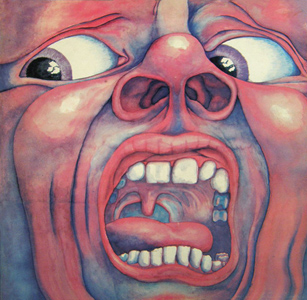
King Crimson
In the Court of the Crimson King
About This Review
Re-Play reviews look back at landmark albums — how they were received at the time of release, the influence they've had on music in the years since, and where they stand today.
At Release
King Crimson played their second-ever concert at the Rolling Stones' free show in Hyde Park in July 1969, in front of an estimated 650,000 people, and by most accounts stopped the crowd cold. They were an unknown band opening for the most famous rock group in the world, playing music that nobody had heard before, and the audience reportedly had no idea how to respond — not because the music was alienating but because it was, even at that early stage, simply more complex and more demanding than anything in the available frame of reference. The Hyde Park performance gave the band a profile that their debut album, released three months later in October 1969, was able to capitalize on. In the Court of the Crimson King entered the UK charts at number 5.
The critical reception was rapturous in Britain and cautious in America, which was a reasonable distribution given that the album's primary debts were to European classical composition, jazz improvisation, and the specific strain of literary Romanticism that British culture had been carrying since the nineteenth century. The American rock audience of 1969 was in the process of absorbing Woodstock and preparing for Altamont; its appetite for a British band playing long-form compositions built from irregular meters and orchestral timbres was, as a matter of cultural logic, limited. Rolling Stone praised the album but placed it in a category apart from the rock mainstream. In Britain, where prog's cultural context was more fully developed, the record was immediately recognized as something exceptional.
The lineup that recorded the album was itself a point of interest: Robert Fripp's guitar, which operated from the first note as a compositional voice rather than a rhythm or solo instrument; Greg Lake's extraordinarily controlled baritone, which had the range and presence of an operatic voice deployed in a rock context; the woodwind and brass arrangements of Ian McDonald, who was contributing ideas that belonged to a tradition the rock audience had not previously been invited to engage with; and Michael Giles's drumming, which managed the difficult task of providing jazz-level rhythmic sophistication within structures that required a rock band's physical force.
The Influence
In the Court of the Crimson King is the foundation on which the entire edifice of progressive rock was built. Yes, Emerson Lake & Palmer, Genesis, and the broader British prog movement of the early 1970s are all, to varying degrees, working out the implications of what Crimson established on this record: that rock music could adopt the formal ambitions of classical composition without ceasing to be physically immediate and emotionally direct; that extended instrumental passages could hold an audience's attention without recourse to blues-derived improvisatory conventions; that a rock album could contain both the sublime and the visceral without the former canceling the latter.
The record's influence extends beyond prog into territories that are less frequently acknowledged. The metal tradition — particularly the more technically ambitious strains of it, from Rush through Dream Theater through Tool — draws heavily from the rhythmic vocabulary and the structural approach that Crimson demonstrated was available to rock musicians. The post-rock movement of the 1990s, from Slint through Godspeed You! Black Emperor, owes a specific debt to the album's understanding of dynamics: the way a composition can move from near-silence to maximum force in a single phrase, using the contrast as the primary expressive mechanism. Even ambient electronic music has roots in the more spacious passages of 'In the Court of the Crimson King' and 'Moonchild,' which deploy silence and texture in ways that anticipated by decades what would later be called ambient composition.
Where It Stands Today
In the Court of the Crimson King has survived the almost total critical demolition of the progressive rock movement that surrounded it. Prog's reputation collapsed under punk's assault in the late 1970s and has never fully recovered — the caricature of self-indulgent excess that punk attached to it has proved remarkably durable. But Crimson's debut has been exempt from that verdict in a way that the later prog canon largely has not. This is partly because the album predates the excesses that gave prog its reputation, and partly because its specific qualities — concision within ambition, darkness within grandeur, genuine menace in the Fripp guitar passages — are not qualities that the caricature can accommodate.
The album sounds extraordinary on a modern playback system. The dynamic range, which was considerable for a 1969 recording, rewards the kind of careful, high-resolution listening that contemporary audio equipment makes available. The separation of instruments in the stereo field, Fripp's guitar tone on '21st Century Schizoid Man,' the interplay between McDonald's flute and Giles's hi-hat work on 'I Talk to the Wind' — these details, which may have been partially obscured in the original vinyl pressing for listeners without access to excellent equipment, are now fully audible and continue to reveal new elements on repeated listening. The record has outlasted both its era and the movement it spawned, which may be the most complete form of vindication available to a piece of music.